


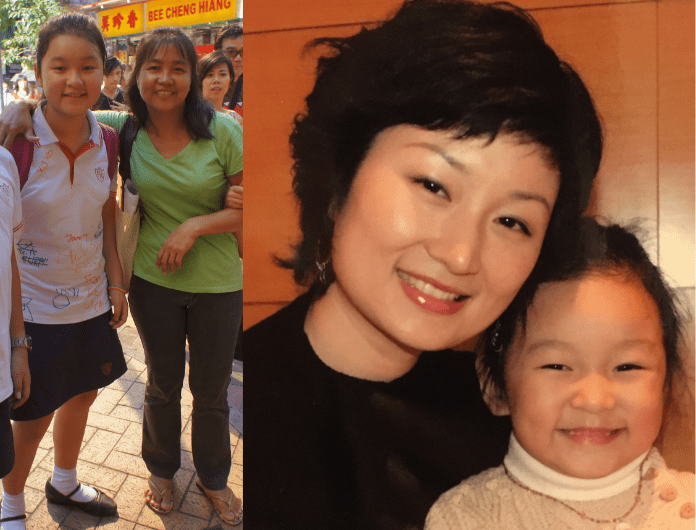
One of the very first pictures of me is not in my mother’s arms, it’s in my Tita’s. I am slung over her shoulder, cooing at the camera as affection gleams through her large smile. Her short black hair was a distinct feature of her appearance, but what I remember most vividly about her was her smell. I didn’t realize it until years later when I had caught a whiff of that nostalgic scent in a store that it was a memory from infancy.
Tita, the Tagalog term for aunt, sister or an endearing older woman, is all I ever knew her as. For many years, I thought that was simply her name; and despite the fact that she had been hired to raise me during my most formative years as an infant, I had never sought to find out what her actual name was. Perhaps I never wanted to see her anything beyond my Tita.
My parents immigrated to Hong Kong from the United States in 1999, and in 2000 I was born. From my birth, my parents had hired a domestic helper — Tita — to care for me and my mother. My mother didn’t work, but would often occupy her time by networking with other women and spending time at the temple. My father worked during the day and coming home to a full course dinner that my helper cooked was an added bonus. When my brother was born in 2002, Tita’s contract had already been up, but my parents hired another helper to supplement the one my household had. This time, it was a pair of sisters called Julie and Jean, both of whom I called auntie.
Domestic helpers first arrived in Hong Kong in the 1970s when the Filipino president, Ferdinand Marcos, began the country’s export of overseas workers as a means to boost the economy. By 1978, labor-export recruiting agencies were privatized, and were an integral part of the Philippine economy.
It seemed normal to me that my brother and I got a helper each. In fact, I never even considered that both our helpers had families of their own back in the Philippines. They had their own children, but their children did not have their mothers while I had three. In 2008, my parents separated. At one point in this process, I started secretly referring to auntie Julie as my “first” mother. Not to her face, but I had the occasional outburst in which I’d angrily shout at my mom, calling her my “second” mother. I can only imagine how that felt for her— going through the stress of a separation and the emotional decline of her children. But I think at that moment, auntie Julie provided me with a safe presence, something that my mother could not give me during that period of unrest.
One in eight households in Hong Kong has a domestic helper, of which one in three households with children has one. They make up 10% of the working population and around 5% of the total population. If you were to walk around the city on a Sunday, the typical day off for most helpers, you would see groups of women sitting on cardboard boxes under bridges, in alleyways and at the World Trade Center in Central.
When I was a child, my helpers used to take me out with them on Sundays including basketball games, meals with their partners and even to church. I thought that all families were close to their helpers just as I was — but this is far from the truth. Numerous accounts dating back to the beginning of the arrival of domestic workers in Hong Kong have reported abuse towards these women, with the 2014 case of Indonesian helper Erwina Sulistyaningsih being the most notorious in recent years.
Sulistyaningsih was 23 when she was hired by a local 44-year-old woman, who abused her over the course of eight months. During that time, Sulistyaningsih was forced to sleep on the floor, work 21 hours a day and was not allowed a day off (all of which are illegal). She was continuously beaten for not cleaning to her employer’s standard, or not answering the phone quickly enough. She noted that she was beaten with various household items, such as hangers, mops and a ruler — inflicting wounds that eventually became infected. Her employer refused to let her see a doctor and instead arranged for her to return to her home country of Indonesia with a measly $70HKD (less than $10USD) and threatened to kill her parents if she told anyone about the abuse. Unable to walk, a fellow domestic helper helped her on the plane back to Indonesia, where she reported the crime and ultimately influenced thousands of demonstrators in Hong Kong to protest against the cruel treatment of domestic workers.
Sulistyaningsih’s case resulted in her employer’s imprisonment, but this result is not seen in many mistreatment and abuse cases in Hong Kong. What constitutes ‘abuse’ is not set, and many employers cannot discern between firmness and verbal abuse. In addition, there is a limit to the number of times a domestic worker can break her contract. Not only will she be looked down upon by future employers as a “Break Contract Helper,” a helper that is high maintenance or looking for a gullible family to take advantage of, but she also may no longer be allowed to work in Hong Kong.
There are various deterrents for reporting abuse and maltreatment. Other than the fear of losing a job or future jobs, many domestic workers simply do not know their rights. Though agencies are required to inform incoming helpers of their rights in Hong Kong, not every helper is hired through an agency (none of mine ever were), thus they may be enduring more than what they need to. But even for those who do report their crimes, what is the repercussion for the abuser? Sulistyaningsih’s case was reported and condemned worldwide, yet her abuser only got sentenced to 6 years in jail and was given parole after serving half her sentence. What does this say about how the government and justice system values the safety and security of one of the city’s most valuable populations?
Many of my helpers were well-educated. They are business owners, nurses, university students and more back in the Philippines. They are caretakers, mothers and contributing members to multiple economies, yet their financial situations forced them to flee the country in search of work. Though they are educated and young, their status is reduced when they take on these roles as domestic helpers. Much like the Black nanny trope that prevents Black women from being seen as anything more than a maid or a housekeeper, lots of Southeast Asian women face a similar dilemma in more developed Asian countries. This is a deep-rooted cultural and societal predicament that adopts a colonial mindset and pits people against each other. But many of Hong Kong’s population wouldn’t have succeeded without their helpers. I personally feel blessed to have been raised by a myriad of talented, intellectual and loving women.
Alana Tse is a Staff Writer for the New University. She can be reached at alanat3@uci.edu.