

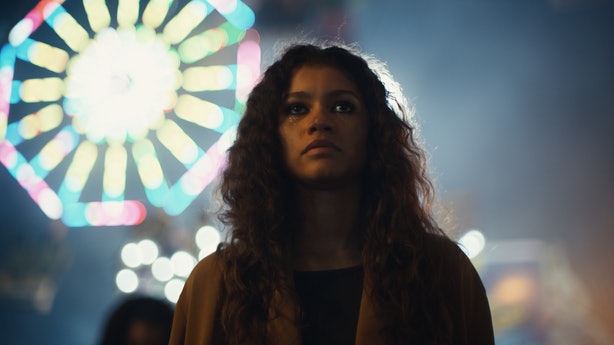

By now, we have likely all been made aware of, if not already fanatical participants in, the “Euphoria” craze. The second season of the hit HBO series, written and directed by Sam Levinson and starring Zendaya alongside a cast of young Hollywood’s most promising break-out stars, has garnered more critical acclaim and mainstream hype than any television show in recent memory.
“Euphoria” doesn’t shy away from controversial or taboo subject matter — rather, that is the show’s entire impetus. The show’s graphic depictions of teen drug use and addiction, sex, and violence are aesthetically delicious and sensually hypnotic. The show itself is drug-like in its addictive and sedative nature. Its cinematography, color gradation and use of non-linear storytelling makes the viewer feel like they’re in a fever dream. It’s basically Gen Z catnip. Strikingly beautiful and elaborately made-up adult actors portray high school students, whose everyday classroom attire consists of cutting-edge, designer fashion and barely-there garments that would certainly warrant a dress code and detention slip at any real high school. But at Euphoria High, anything goes. The simultaneous, interwoven plotlines propel the narrative forward, with dialogue that is equally smart as it is provocative.
However, there is a growing conversation over whether “Euphoria,” in its aesthetic appeal combined with its extremely sensitive and adult material, is unsuitable for teen audiences. The Drug Abuse Resistance Education program (D.A.R.E.) has voiced criticism of the show’s depiction and glorification of drug abuse and other high-risk behavior.
D.A.R.E. was established in 1983 as part of the Reagan-era initiatives to clamp down on drug abuse, acting as an extension of the War on Drugs, along with the “Just Say No” campaign aimed at the youth. It has served, at least in theory, to equip schools — from grades kindergarten to high school — with educational strategies to help children and adolescents resist the peer pressure of drug use, operating on a “zero-tolerance” philosophy. The program is regarded by and large as a failure, costing almost a billion dollars annually in taxpayer dollars during its peak in the 1990s with very little evidence to support its efficacy. Many critics of the initiative argue that its use of law enforcement officers to lead classroom discussions, highlighting punitive consequences for substance abuse over rehabilitative education, was also a reason for its failure to reach teens. Since the program’s inception, rates of drug and alcohol consumption have steadily risen among high school and college-aged students.
This is already shaping up to be a losing battle for the organization against television’s currently most talked-about series. In the same way that D.A.R.E. programs in schools ultimately backfired across the nation, its criticisms of “Euphoria” are also likely to do the opposite of their intended effect. We now know that attempts to shield teens from these issues and fear tactics only lead to more curiosity down the line.
It is difficult to imagine how a person, regardless of age or maturity, could sit down to watch an episode of “Euphoria” and come away with a desire to experiment with or abuse drugs. After watching the show’s main protagonist Rue (Zendaya) repeatedly destroy herself and her relationships due to her opiate addiction, the glamorization argument is weak. Zendaya also responded to D.A.R.E.’s criticisms by emphasizing that the show is not meant to be a “moral tale,” but rather to humanize issues like drug addiction.
While “Euphoria” might present a surreal, exaggerated version of the modern teenage experience, it also offers a heavy dose of realism, particularly in its writing and acting. Eye-candy aside, the show is resonant because of its earnestness and accuracy in capturing the underlying sentiment of what it’s like to come of age in current times. Perhaps one of the reasons for the show’s popularity is that it doesn’t coddle or presume that its viewers will be unable to digest difficult subject matter. It is also absent of an ideological agenda — it doesn’t moralize or virtue-signal, but it also doesn’t glorify. We as viewers need the sensational stuff not only for the sake of art but to shift the conversation onto these difficult subjects. It sets a terrible cultural precedent if we start blaming and holding art and entertainment accountable for society’s troubles.
The allure of “Euphoria,” and its inherent power, is in the fact that it isn’t righteous or preachy. The fact that it doesn’t have D.A.R.E.’s seal of approval tells us that it’s doing something right.
Melissa Newell is an Opinion Intern for the winter 2022 quarter. She can be reached at mrnewell@uci.edu.